
What is move-based programming
Move-based programming is a resource-oriented approach to smart contract development that treats digital assets as unique, non-copyable entities. This model eliminates entire classes of vulnerabilities, such as double-spending and unauthorized duplication, by enforcing strict ownership and lifecycle rules at the compiler level.
Why Move Prevents Asset Theft
Move secures blockchain assets through a strict resource-oriented model. In traditional programming, data is often treated as generic information that can be copied, discarded, or modified without consequence. Move treats digital assets as unique resources. This means an asset is not just a value; it is a distinct entity that must be explicitly managed, transferred, or destroyed.
This design eliminates the most common attack vectors in smart contracts. Because resources cannot be copied, a contract cannot accidentally create a second version of a token or NFT. If code attempts to duplicate a resource, the Move compiler rejects the transaction immediately. This ensures that the total supply of any asset remains accurate and verifiable at all times.
Move also enforces strict ownership rules. Assets are tied to specific accounts or containers within the blockchain state. They cannot be accessed or moved unless the contract explicitly grants permission. This prevents unauthorized transfers and ensures that assets remain under the control of their rightful owners until a valid transaction is executed.
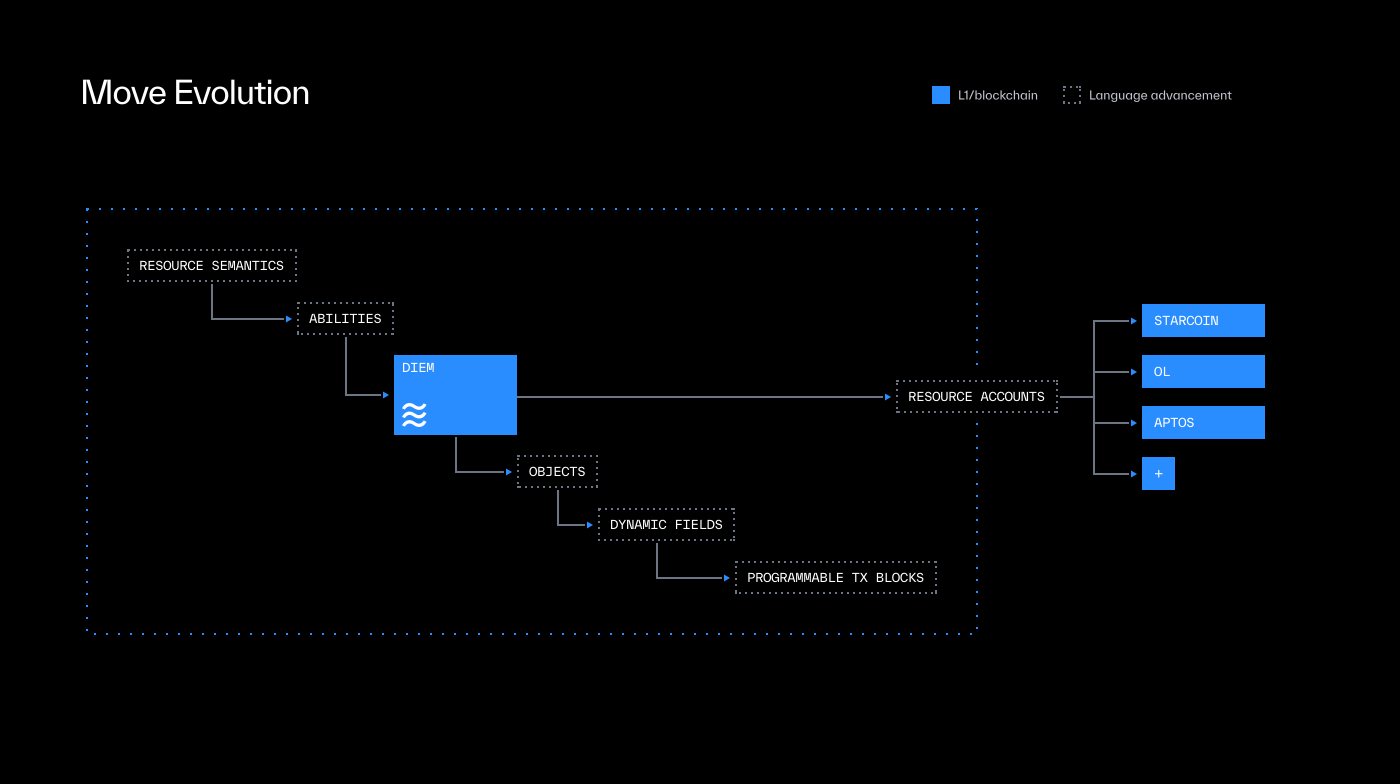
By treating assets as first-class citizens with strict lifecycle rules, Move provides a higher level of correctness than languages that rely on software-level checks alone. This makes it the preferred standard for applications where asset integrity is non-negotiable.
How Move Handles Digital Assets
Move treats digital assets not as simple data, but as first-class citizens through its resource model. This resource-oriented approach ensures that every unit of value has a single, unambiguous owner at any given time. Unlike standard programming types that can be easily duplicated or ignored, resources are bound by strict compiler-enforced rules that prevent common blockchain vulnerabilities.
Ownership and Transfer
In Move, a resource is an object that cannot be copied or dropped implicitly. When you create a resource, it must be explicitly owned by an account or another resource. This ownership constraint is the foundation of security. If a developer attempts to copy a resource without an explicit @copy annotation, or destroy it without @drop, the Move compiler rejects the transaction before it ever reaches the network. This prevents accidental loss or inflation of assets.
Transferring assets requires an explicit action. A resource cannot simply move from one account to another in the background; the code must explicitly transfer ownership. This transparency makes auditing easier, as every change in state is a deliberate operation in the transaction log. The language guarantees that if a transfer fails, the resource remains in its original state, preserving integrity.
Destruction and Lifecycle
The lifecycle of a Move resource is strictly managed. A resource exists until it is explicitly destroyed or transformed into another type of resource. This is critical for burn mechanisms or escrow contracts, where assets must be permanently removed from circulation or locked until specific conditions are met. Because the compiler tracks all resources, it is impossible to "leak" value by losing track of an object reference. If a function finishes without using or transferring a resource, the transaction fails.
This deterministic lifecycle eliminates entire classes of bugs found in other smart contract languages. Developers do not need to rely on runtime checks or external audits to ensure assets aren't being duplicated; the language structure itself makes such attacks impossible. By binding security to the type system, Move provides a robust framework for building financial applications where correctness is not just a goal, but a guarantee.
Move vs Rust for smart contracts
Rust is the dominant language for blockchain development, powering ecosystems like Solana and Substrate. It offers general-purpose performance and a vast ecosystem, but its complexity can introduce subtle vulnerabilities in asset management. Move was designed specifically to address these gaps, prioritizing asset safety over raw flexibility.
The core distinction lies in how each language handles digital assets. Rust uses standard ownership models that, while powerful, require careful manual management to prevent errors. Move introduces a resource-oriented model where assets are first-class citizens. This means resources cannot be copied or discarded implicitly; they must be explicitly moved between accounts or destroyed. This structural constraint makes it significantly harder to write contracts that accidentally leak or duplicate value.
| Feature | Rust | Move |
|---|---|---|
| Primary Focus | General-purpose systems programming | Secure smart contract development |
| Asset Handling | Standard ownership; copyable by default | Resource-oriented; non-copyable by default |
| Safety Model | Relies on developer discipline and borrows checker | Enforces asset safety at the language level |
| Learning Curve | Steep; requires deep understanding of memory safety | Moderate; simpler abstractions for blockchain logic |
While Rust provides a broader toolkit for performance-critical systems, Move’s specialized design reduces the attack surface for common blockchain exploits. For developers focused on securing blockchain assets, Move’s resource-oriented approach offers a more direct path to correctness than adapting general-purpose Rust patterns.
Where Move is used today
Move has moved beyond experimental prototypes to become the foundational language for high-security blockchain ecosystems. The two primary networks built on this architecture are Sui and Aptos. Both chains selected Move to solve the specific vulnerabilities found in earlier smart contract platforms, prioritizing resource-oriented safety over flexible but fragile composability.
Sui, launched by Mysten Labs, uses a variant of Move called MoveSui. It leverages Move’s object model to enable parallel transaction execution, allowing the network to process thousands of transactions per second. By treating digital assets as distinct resources that cannot be copied or discarded without explicit permission, Sui ensures that asset transfers are atomic and secure. This approach directly addresses the reentrancy attacks that have historically drained funds from other blockchains.
Aptos, founded by former Meta engineers who originally developed Move for the Diem project, uses a version called Aptos Move. It focuses on strict type safety and formal verification. Developers can mathematically prove that their smart contracts adhere to security invariants before deployment. This reduces the attack surface for exploits, making it suitable for financial applications where correctness is non-negotiable.
The choice of Move in these ecosystems reflects a shift toward "resource-oriented" programming. In Move, assets are not just data; they are first-class citizens with strict ownership rules. This design prevents common bugs, providing a more robust standard for blockchain security.
Common questions about move
Move addresses specific security gaps in smart contract development through a resource-oriented model. Below are answers to frequent technical queries regarding its origins, core concepts, and design philosophy.
No comments yet. Be the first to share your thoughts!